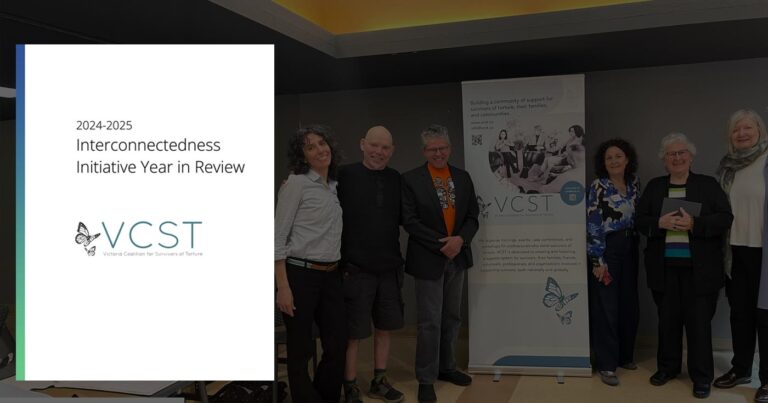
Interconnectedness Initiative year in review, 2025-2026
VCST did much work this year in expanding our reach to include more communities of survivors.
We are excited to announce that VCST’s Interconnectedness Initiative has received funding from the Victoria Foundation for the next phase! With this phase, we will continue to offer professional development…
In March 2026, VCST conducted qualitative interviews with senior managers from five organizations that provide services to immigrants and refugees on Vancouver Island. These interviews are part of our long-term…
In April, VCST teamed up with the Vancouver Association of Survivors of Torture (VAST) to lead a Victoria-based session of their project Building Resilience and Understanding Against Hate. These thoughtful…
A review of gaps and best practices in referral systems between settlement and healthcare/counselling agencies.
Despite decades of global drug control efforts, primarily led by the US throughout the 20th century and more specifically in the 1970s (also known as the “War on Drugs”), illicit…
Integrated Mental Health Care for Refugees: What works, for whom and why.
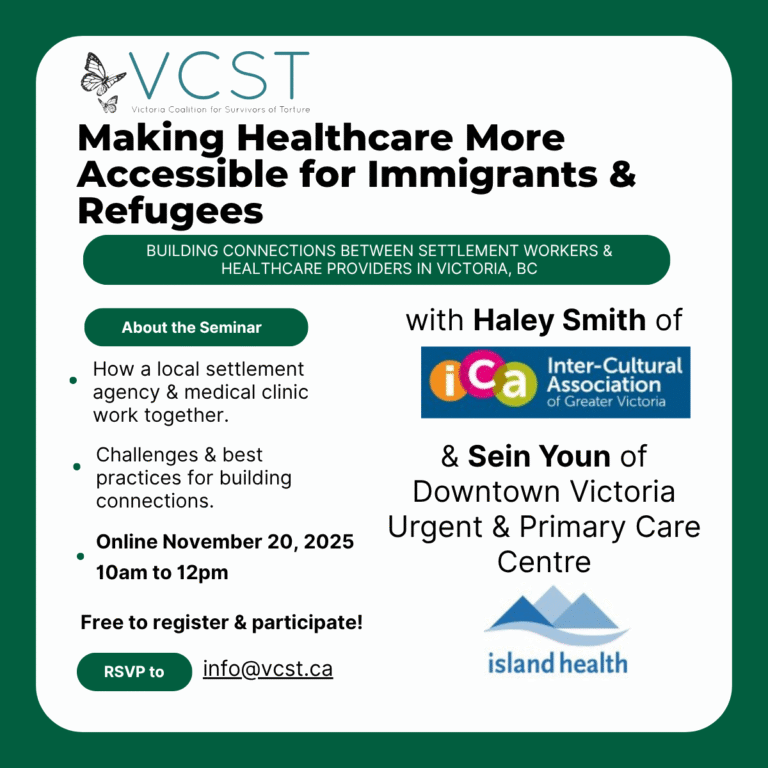
Thursday November 20, 2025, 10am to 12pm Where: Online, Zoom Who: Workers in settlement, counselling, mental health, healthcare, and any other sector that works with immigrants and refugees RSVP: info [at]…
The term, “stakeholders”, not only refers to the act of land dispossession but also reflects a colonial mindset about ownership, entitlement, and division which marginalizes Indigenous Peoples.
It is thanks to the Victoria Foundation that we can launch Phase IV of our initiative.
Thanks to the ongoing support from the Victoria Foundation, Phase III of VCST’s Interconnectedness Initiative came to a successful conclusion in July 2025.
The fourth case conference of the I.I. took place on March 27, 2025, with the participation of 13 people from seven organizations
Interconnectedness Initiative research report and key findings.
“Case Conferencing” was identified by stakeholders as an essential tool to address sensitive cases among survivors of torture in the region, and to bring forward the experiences of the project’s stakeholders.
The project, funded by the Victoria Foundation, has undertaken a comprehensive approach to address the needs of survivors of torture in our community.
© 2025 VCST | From lək̓ʷəŋən land
Site supported by Pink Sheep Media.