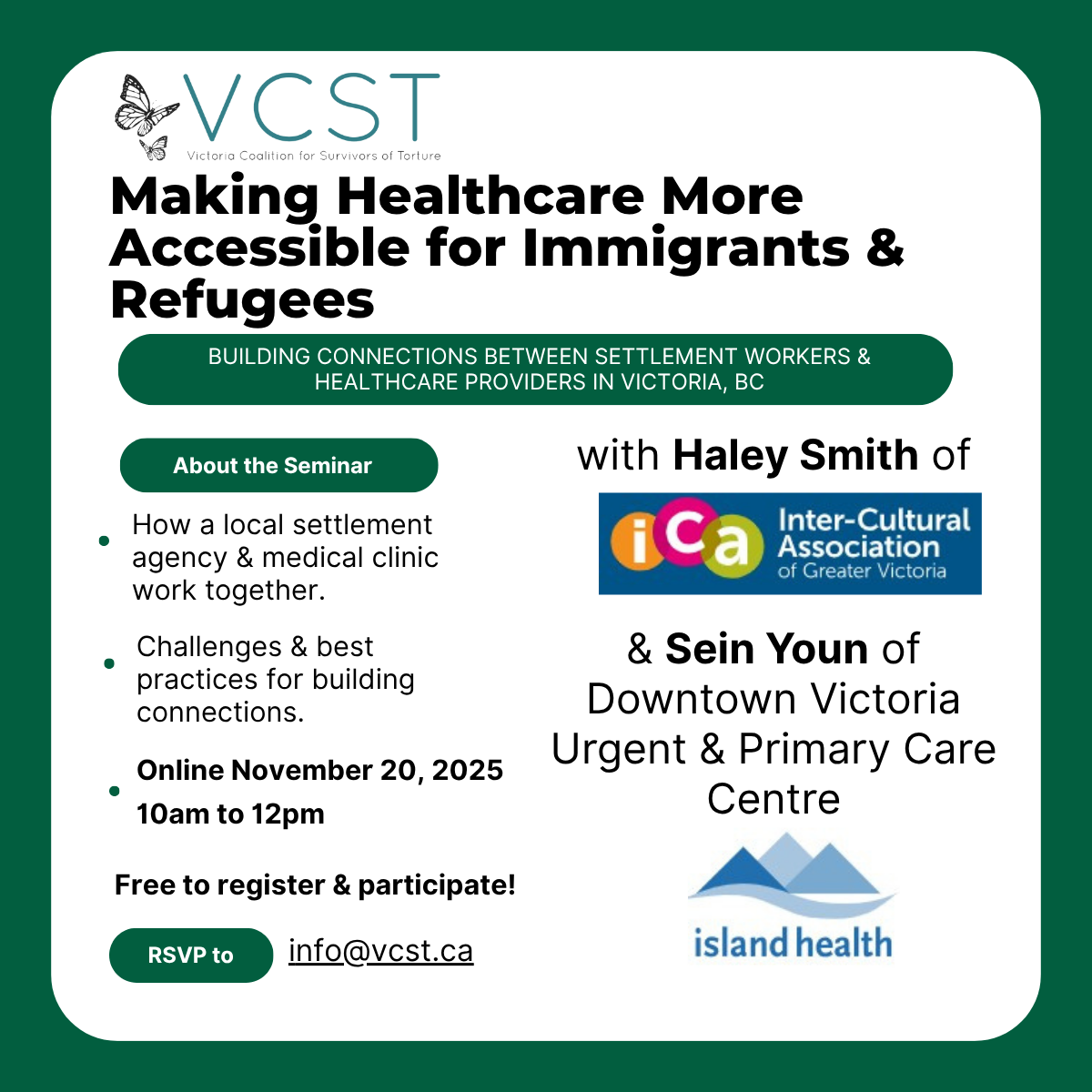
RECAP: Making healthcare more accessible for immigrants & refugees
Building Connections between Settlement Workers & Healthcare Providers in Victoria, BC
With Haley Smith (ICA) and Sein Youn (DVUPCC)
Summary report
The Victoria Coalition for Survivors of Torture (VCST) hosted a seminar in November 2025 on healthcare access for immigrants and refugees, featuring Haley Smith, Healthcare Navigator from the Intercultural Association of Greater Victoria (ICA) and Sein Young, Refugee Nurse from the Downtown Victoria Urgent and Primary Care Centre (DVUPCC).
This seminar was an important part of VCST’s Interconnectedness Initiative, a network of organizations responding to the needs of survivors of torture and systemic violence, and working to increase public awareness of their presence in our communities. Our collaborative professional events – such as this seminar – aim to share knowledge and build capacity among our member organizations.
Before the seminar, we circulated a background paper (see heading “Background”), which describes some of the barriers to healthcare access that survivors of torture and systemic violence face as immigrants and refugees.
The focus of our seminar was to learn from two colleagues who are working hard to improve newcomer health outcomes through a collaborative cross-sector referral process that works to provide continuity of care.
How ICA & DVUPCC work together
We heard from both Haley and Sein about the history of the collaboration between their two organizations. ICA works with around 5,000 newcomer families – a number that increases monthly – and refers clients to DVUPCC for medical care. The DVUPCC refugee clinic currently receives referrals from a variety of sources including ICA, but also VICCIR (Vancouver Island Counselling Centre for Immigrants and Refugees), VIRCS (Victoria Immigrant and Refugee Centre Society), private refugee sponsors, and word of mouth. DVUPCC can also refer clients back to VICCIR for mental healthcare. DVUPCC works with about 450 clients.
Haley assists newcomers with high medical needs and barriers to care, strengthens community partnerships with healthcare providers and organizations, and runs health-related workshops and groups. She explained how budget cuts have affected ICA’s ability to provide services, but emphasized a shared commitment with DVUPCC to adapting to fewer resources for a growing population. In her work, Haley communicates frequently with Sein about client needs and healthcare programming to increase healthcare resources for her clients. For Haley, the ICA-DVUPCC connection is essential for supporting a continuity of care for immigrants and refugees.
Sein provided an overview of the DVUPCC’s refugee clinic, which has been providing medical care to refugees since 2021. She shared her experience of working with clients over a few years and noted that sometimes mental health issues, like anxiety and depression, can develop within people after the initial excitement of moving to Canada.
Both Sein and Haley shared a perspective that some of the major challenges in providing appropriate medical care to this population include a lack of resources, funding, and healthcare professionals’ willingness to work with this community. Issues such as language barriers, the need for interpreter services and proper training to use the service, and cultural differences can prevent some medical professionals from working with newcomers. Add this onto an already overloaded healthcare system, and barriers to care start to multiply.
However, some tools and best practices to improve healthcare access are already in place. For example, both Sein and Haley emphasized the importance of using the Provincial Language Services (PLS). This free service is available 24 hours a day for the healthcare sector.
They also highlighted the need for providers to learn about the different healthcare coverage for immigrants and refugees (for example, the Interim Federal Health Program/IFHP) to better understand how they can work within the system to provide care.
Our discussion also turned to the importance of including medical practicum students into the settlement and clinical setting to inspire future medical professionals to work with this dynamic and diverse community.
Our group discussion touched on subjects such as providing culturally competent care and training and practice in working with an interpreter to build trusting relationships with clients. The seminar was an important opportunity for settlement agencies and healthcare providers on Vancouver Island to learn how this settlement-healthcare referral system works and best practices to implement a similar collaboration in their home communities.
If you’d like to learn more about this important system working to improve newcomers’ access to healthcare, please contact us (info [at] vcst dot ca) for more resources.
Background: How survivors interact with the settlement & healthcare sectors
The population of survivors of torture and systemtic violence settling in North America has been increasing in recent decades. This is partly due to growing systemic violence around the world, such as increased drug trafficking and armed conflict (Rustad, 2025), combined with increased migration flows to Canada via refugee and asylum pathways (Statistics Canada, 2025). By mid 2025, 123.2 million people in the Global South were forcibly displaced and in need of international protection due to war, violence, and human rights violations (UNHCR, 2025). Survivors are among this massive, dispersed population.
In 2019, the UN High Commissioner for Refugees estimated that in Canada “30% of resettled refugees were survivors of torture or violence” (UNHCR, n.d.). The 2021 Canadian Census states that there were 6,295 refugees on Vancouver Island. Therefore, VCST estimates that around 2,000 survivors are living on Vancouver Island. This figure only includes survivors that are refugees and that fit the UNHCR definition of “torture” and may not include survivors of different kinds of systemic violence and armed conflicts or survivors entering Canada along different immigration paths.
Statistics about survivors are difficult to collect – some say “impossible” (Board et al. 2021, p. 292) – for many reasons. Duffy and Kelly (2015) note the “reluctance of these populations to engage with services, especially in a formal or clinical setting” (p. 106), while Dehghan and Wilson (2019) identify mistrust in authority, shame, language barriers, and racism as a few of the factors modulating how survivors engage with healthcare, research, and immigration staff. Echoing these findings, VCST (2025) found that settlement and counselling agencies on Vancouver Island and in the Lower Mainland learn that some of their clients are survivors only via long-term trust building. This disclosure occurs in a trauma-informed environment of trust, rather than clinical systematic data collection.
Survivors experience high levels of mental and physical health issues related to their living experiences of torture and trauma. For example, a recent systematic review found an estimated prevalence of Post Traumatic Stress Disorder (PTSD) and depression for refugee and asylum seekers greater than the general population: 31% greater for PTSD and 31.5% greater for depression (Blackmore et al., 2020). Furthermore, psychological concerns can manifest as chronic pain – in more than 80% of survivors (Board et al. 2021) – diabetes risk, and high blood pressure (Hvidegaard et al., 2023).
Root causal factors for survivors’ mental and physical health conditions are connected to social determinants of health. Research has shown that social determinants such as poverty and unemployment (Rousseau & Frounfelker, 2019), host country discrimination (Abu Suhaiban et al., 2019), and lack of social support (Mitchell & Correa-Velez, 2009) can negatively influence survivors’ health. On the individual level, barriers to services can include survivor lack of health literacy (Board et al., 2021), language barriers (Raghavan, 2018), and cultural stigma, fear or shame related to their experience (Board et al., 2021; C de C Williams & van der Merwe, 2013).
Many studies have identified multiple systemic barriers within Western medical systems that can negatively influence a survivor’s healthcare experience. A few of the barriers survivors must grapple with are: lack of provider awareness of torture and trauma (Board et al., 2021), systemic racism (Williams et al., 2022), Western-based pathologies being misapplied to people from around the world (Raghavan, 2019), language and communication gaps in services (Pottie et al., 2017), and generally recognized health inequity (Pottie et al., 2017).
In Canada, settlement agencies provide survivors with housing support, food security, language learning, and social connections. Many survivors engage with the healthcare and mental health system via settlement agencies, which refer clients to clinics and counselling (VCST, 2025). Though these referrals extend settlement agency services, this system risks retraumatizing survivors. Research shows that some systems for healthcare access can be retraumatizing by requiring a survivor repeatedly: tell their story as they are transferred between doctors and organizations to complete multiple intakes, a common retraumatization trigger (Herman, 1998); interact with new people/organizations without having built trust (Burnett & Ndovi, 2018); and overcome language and cultural barriers in a healthcare setting, which Raghavan (2018) found “may exacerbate refugees’ anxiety”.
VCST hypothesizes that these issues are present in the settlement-healthcare referral system. Gaps exist in directly documenting survivors’ experiences with the referral system between settlement and healthcare/counselling agencies. However, the extensive academic and medical research points to essential best practices when referring survivors between settlement agencies and healthcare providers. These include:
- Adopting a whole-person approach to settlement, counselling, and healthcare
- Working with a healthcare navigator to improve client healthcare literacy
- Implementing trauma-informed care in all interactions to build trust
- Filling gaps in language and translation services in the healthcare setting
- Minimizing number of times clients are asked to repeat their medical histories
- Educating healthcare providers on providing trauma-informed, culturally appropriate care
- Building cross-sector connections to ensure continuity of care
- Following-up with survivors regularly, to continue to build trust, and to make sure they are successfully receiving the long-term attention they may need
VCST’s Interconnectedness Initiative is funded by the Victoria Foundation.