2024-2025 Interconnectedness Initiative Year in Review

Thanks to the ongoing support from the Victoria Foundation, Phase III of VCST’s Interconnectedness Initiative came to a successful conclusion in July 2025. Launched in September 2024, this phase started off by welcoming Melinda Quintero as Project Manager. Melinda brings nearly two decades of experience as a project manager and editor for print publications. Her commitment to the project became clear from the very beginning and together we were able to surpass the activities planned for this year.
Community reach
Our list of contacts increased to 54 people, representing 23 organizations. We maintained our focus among partner organizations in Greater Victoria, but we also welcomed service providers operating elsewhere on Vancouver Island and Metro Vancouver. Their experience working with survivors of torture and systemic trauma in their communities proved to be a valuable learning opportunity for our partners in Greater Victoria.
We hosted six in-person and online events for our member organizations and community partners. Our events were well-received, with 112 representatives of community organizations attending.
Deliverables

The following is a summary of the activities completed for each deliverable during this period.
1: A collaborative prevention program to stop or reduce the cycle of abuse/violence that survivors may carry with them into their relationships will be established. The expertise of the member organizations will be shared and utilized.
- In February 2025, we published our participatory action research findings to share our member organizations’ strengths and opportunities. We conducted 10 qualitative interviews with eight member organizations to discuss their programs, culture, needs, and strengths. We combined this data with website content analyzed using Maslow’s Hierarchy of Needs. With these two sets of data, we identified common themes in the work of our member organizations. The Interconnectedness Initiative Research Report: Stakeholder Strengths and Opportunities is available on our website.
- The Research Report also includes an inventory and classification of services offered by our member organizations; this provides an overview of programs within the settlement and mental health services sector.
- We designed the workshop and presentation “What is Torture?”. We presented this to the Victoria Sexual Assault Centre (October 2024), the Greater Victoria Police Diversity Action Committee (March 2025), and the Greater Victoria Police Victim Services (GVPVS; April 2025).
- We established a Listserve, where resources are shared on a monthly basis with project partners and contacts.
- Our social media work is ongoing, with posting to Facebook and LinkedIn, plus posting reports and information about our events to our website. This activity has been included in the VCST strategic plan as an important communication and knowledge dissemination tool.
2: A collective strategy to prevent the re-traumatization of survivors that occurs in the community will be designed and established. This will be transferable to each of the member organizations as well as could be used in the wider community.
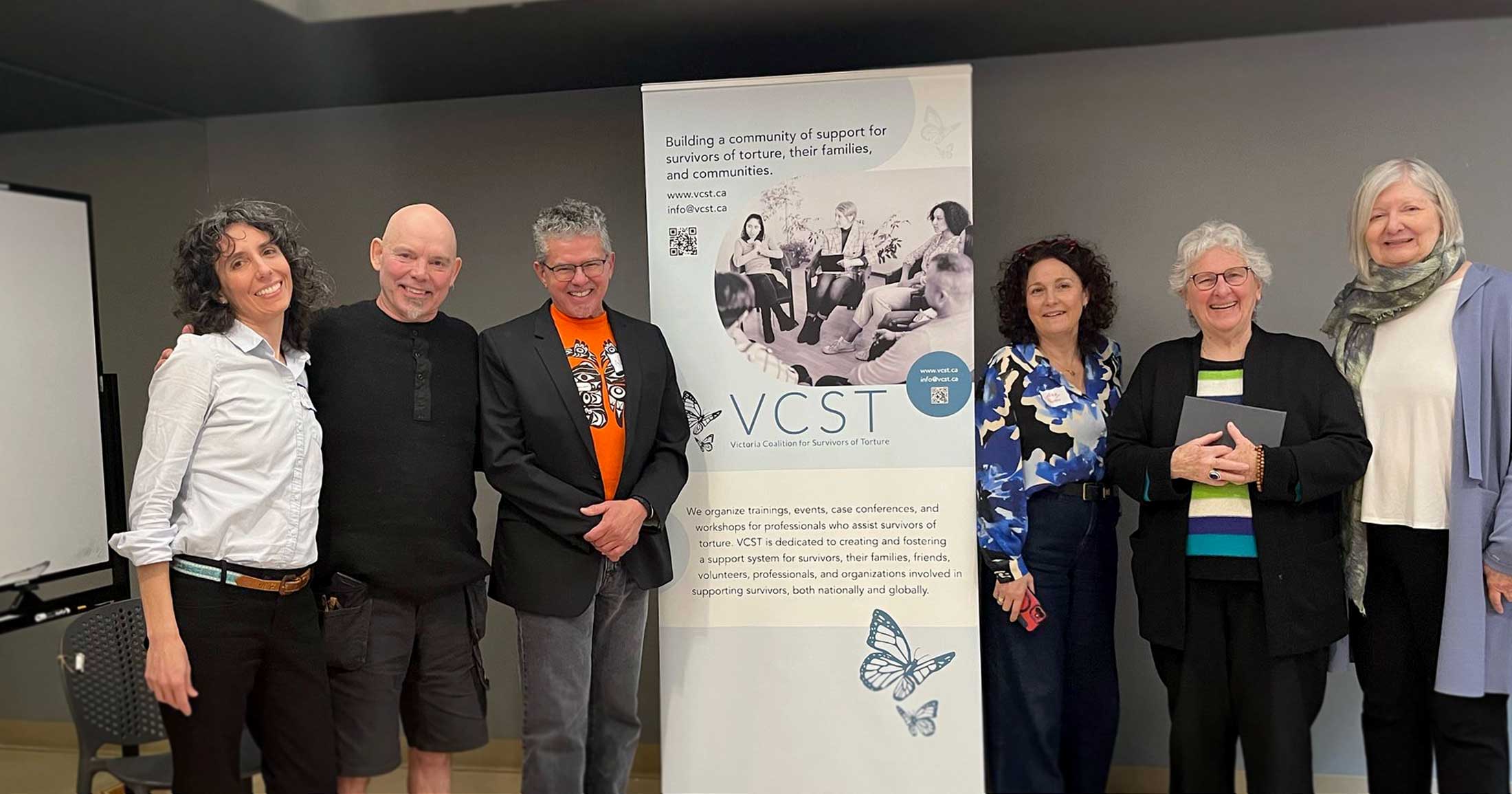
- In February 2025, we hosted a professional development event for our member organizations about the Canadian Model of Care: Breaking Silence; Circles of Support. This was presented by prestigious scholars Joan Simalchik, founding Executive Director of the Canadian Centre for Victims of Torture; and Yaya de Andrade, retired psychologist, Board-certified member of the American Academy of Experts in Traumatic Stress, and a co-founder of the Vancouver Association for Survivors of Torture (VAST), and the Canadian Network for the Health and Human Rights of Survivors of Torture and Organized Violence. Photo: VCST Team with Yaya and Joan.
- In May 2025, we brought back Yaya to deliver an online workshop with VCST board president Ana Pavon, called “Understanding Burnout and Vicarious Trauma” among frontline and settlement workers. We recommend revising this workshop to make it more participatory and client-oriented.
3: VCST and the member organizations have established regular case conferencing. Strategies to strengthen holistic services for torture survivors and their families are being devised and initiated.

- Fourth Case Conference: Presented online with Central Vancouver Island Multicultural Society (CVIMS), March 2025. Summary report available on our website.
- VAST Symposium Presentation (February 2025); VCST board President Ana María Pavon and Project Manager Melinda Quintero presented at the Vancouver Association for Survivors for Torture (VAST) Annual Symposium about the Interconnectedness Initiative Research Report findings.
Melinda presenting at the VAST Annual Symposium.
4: The VCST phone line will become a more integrated tool for oversight, referral, problem-solving, and support for service providers such as settlement workers, sponsorship groups, healthcare workers and the public. The phone line will be a venue for collaboration, team building and awareness of the vulnerabilities of our system of support for torture survivors and their families.
- This deliverable was revised in April 2025 to address concerns regarding duplication of efforts and efficiency in the use of the phone line. We agreed to focus on using it to maintain networking contact with our project members, and ensure they are informed about our progress. Email communication has been very effective, and phone follow up has not been necessary. We recommend cancelling this activity.
Networking and member organization development
- Board member Muna Zaidalkilani wrote an abstract for the International Academy of Law and Mental Health Conference (for Montreal July 2026).
- Project Lead Álvaro Moreno has been attending the meetings of the Canadian Network for Survivors of Torture and Trauma (CNSTT), to share our project activities and promote advocacy and research at the national level.
- Álvaro has also been attending the Greater Victoria Local Immigration Partnership (GVLIP), to maintain networking activities in the health and inclusion committees, to promote our project activities and share our project reports.
- We established contact with the following organizations: Men’s Therapy Centre, Victoria Child Abuse Prevention & Counselling Centre (VCAPCC), Greater Victoria Police Diversity Action Committee (GVPDAC), and the Greater Victoria Police Victim Services (GVPVS). We anticipate closer activities with these and other service providers, to raise awareness about torture survivors and serve as a resource to help when they come across survivors of torture and their families among their service base.
Publications
Pavon, A. M., & Quintero, M. (2025, May). VCST Interconnectedness Initiative: A Local Model of Collaboration. Voices Against Torture. Vancouver Association for Survivors of Torture (VAST). https://www.vastbc.ca/articles/vcst-interconnectedness-initiative-a-local-model-of-collaboration
Quintero, M., Zaidalkilani, M., & Moreno, Á. (2025). Interconnectedness Initiative Research Report: Stakeholder Strengths & Opportunities. Victoria Coalition for Survivors of Torture (VCST). https://www.vcst.ca/2025/02/interconnectedness-initiative-research-report-1312/
Looking to 2025-2026
The Victoria Foundation approved funding for the stage IV of the Interconnectedness Initiative. We look forward to maintaining our networking effort.
To expand our work, we have also submitted a grant application to the BC Law Foundation. This proposal aimed to address systemic barriers that prevent access to legal aid and protection services, develop training for service providers on legal rights, pathways to protection, and trauma-informed advocacy, and conduct research on legal gaps affecting survivors and propose policy recommendations.
We are currently working on a proposal to the Vancouver Foundation, for a participatory action research grant with Dr. Nancy Clark of UVic as the academic partner. This proposal builds on the findings and recommendations arising from the Interconnectedness Initiative and aims to document the experience of survivors of torture and trauma when accessing mental health services in Greater Victoria and the Lower Mainland.
We look forward to continuing with our work in the next period, thanks to the ongoing support from the Victoria Foundation.