
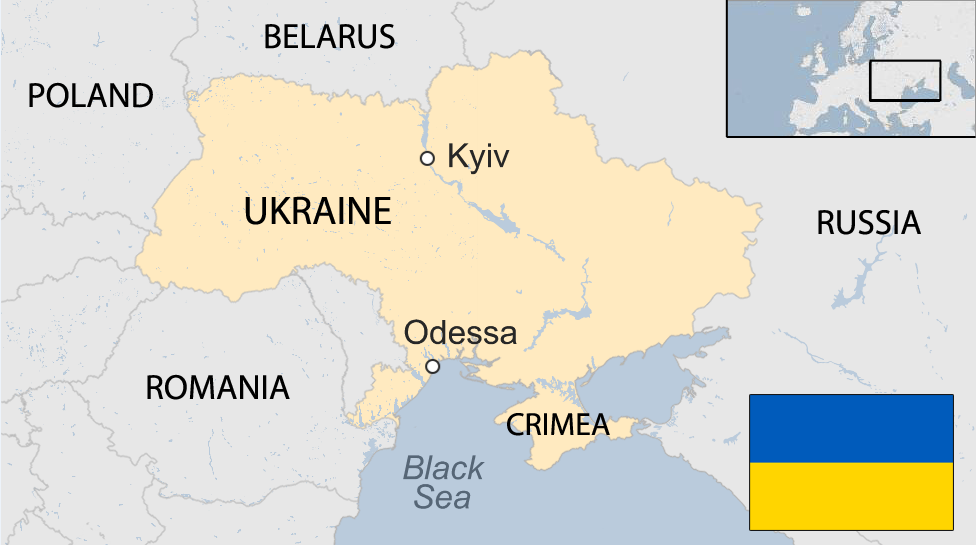
- Capital City: Kyiv
- Area: 603,550 km sq
- Population: 33.4 million
- Official Language: Ukrainian
- GDP per capita: 5,389.47 USD (2024)
- Life Expectancy: 68 years (men); 77 years (women)
Ukraine is the largest country in Europe after Russia. Ukraine is 603,550 km², representing 6% of Europe’s territory. It is a country of wide, fertile agricultural plains, with large pockets of heavy industry in the east. Ukraine sits on the northern shores of the Black Sea, an important geo-political position for trade and transportation.
Ukraine and western Russia share common historical, cultural and linguistic origins dating back hundreds of years. In the 20th century, Ukraine suffered the extreme Holodomor famine under Stalin and the devastating loss of life during World War II. In the post-war period, Ukraine was part of the USSR, but declared independence in 1991, two years after the fall of the Berlin Wall in November 1989.
As a nation between the European Union (EU) and Russia, Ukraine oscillates between seeking closer integration with the EU and being drawn into the orbit of Russia, which sees its interests threatened by a Western-leaning Ukraine.
The Orange Revolution of 2004-2005, was a series of massive, peaceful public protests in Ukraine, triggered by widespread reports of fraud in the presidential runoff election between opposition candidate Viktor Yushchenko and government-backed Viktor Yanukovych. Following the disputed vote, hundreds of thousands of Ukrainians, wearing the orange campaign colour of Yushchenko, engaged in sustained civil disobedience, strikes and sit-ins. The protests culminated in a Supreme Court decision that mandated a new runoff. In the December 26, 2004 re-vote, Yushchenko emerged victorious, affirming popular will over authoritarian control, and reorienting the country towards the West.
As Yushchenko lost popularity in the following years, Viktor Yanukovyk was elected. He was pro-Russian and rejected an EU-Ukraine association agreement, setting off the Euromaidan protests in 2013; the US and the EU favoured his overthrow in 2014. Another pro-western president was elected (Petro Poroshenko, 2014 to 2019), followed by pro-western Volodymyr Zelensky, who was elected president on April 21, 2019.
Earlier in 2014, Russia annexed the Crimean peninsula and encouraged armed separatist groups to occupy parts of eastern Ukraine. The Russian army eventually launched a full-scale invasion in February 2022. Some estimates suggest that more than 1 million Russian and 55,000 Ukrainian military personnel have been killed in Europe’s largest war since WWII, while the UNHCR estimates around 15,000 Ukrainian civilians have died to date.
The United Nations has called attention to war crimes, including torture, committed by Russian troops in the regions Kyiv, Chernihiv, Kharkiv and Sumy – all in the extreme east of the country. Amnesty International has raised alarms about war crimes committed in the Kyiv suburbs of Bucha and Borodyanka.
The war has displaced millions of Ukrainians, with some estimates as high as 10 million people being forced from their homes. Forced migration due to war can exacerbate the already traumatizing experience of living through war. Many Ukrainian refugees internally and abroad experience high levels of PTSD, anxiety, depression and insomnia.
In March 2022, the Canadian Government introduced the Canada-Ukraine Authorization for Emergency Travel (CUAET), as a temporary immigration program. The deadline to apply closed in April 2023. As for April 2024, 1,189,320 applications were received, 962,612 applications were approved, and 298,128 Ukrainian refugees had arrived.
The presence of Ukrainian refugees in Canada is not new. The Ukranian-Canadian Congress reports that, by 1914, some 170,000 Ukrainian refugees had settled in Canada, mainly as farmers. Many more Ukrainian immigrants arrived in Canada after WWII, fleeing the USSR communist regime.
By some accounts, recent Ukrainian refugees in Canada have received a warm welcome by the government and Canadians generally, partially due to an already existing network of Ukrainian-Canadians and their geopolitical status as a low security risk, compared to Somalis, Afghans and Syrians who report systemic and societal racism. However, this does not make Ukrainian refugees immune to common pressures and difficulties that many refugee communities face. Ukrainians in Canada report compounding difficulty navigating the healthcare system, frustration with language barriers, anxiety over loss of professional standing and stress from family separation, among others.
